Zoom Session from Oct 19, 2025
Moderated by Ann Rader. Sarah Mackowski, who is leading the effort to put this exhibit together, started with a brief overview of what’s known so far. Sarah volunteered because she has a Master’s Certification in Museum Studies.
This exhibit will feature weaving and spinning from guild members and is the focus of this year’s Guild Challenge. Hopefully many of us can bring our work to the last guild meeting of the year on June 2, 2026 for Show’n’Tell.
Our exhibit is part of a celebration of the 250th anniversary of the signing of the Declaration of Independence organized as Handwork 2026: Celebrating American Craft. The celebration is being organized by Craft in America, the Smithsonian American Art Museum, the American Craft Council, PBS, and others.
WGGB is an official participant in the collaboration. Other participants include dozens of individual artists, museums, galleries, art and craft centers, cultural centers, arts commissions, colleges and universities, craft schools, and guilds around the country.
To Help You Prepare for the Exhibit
The main theme of the WGGB exhibit will be “Tradition and Innovation.” (This link includes more specific details.)
Here are some specific suggestions for what you might consider making. Weave or spin something that looks historic, or that takes its inspiration from history. Create something that shows innovation in handcraft. Make something about the 250th anniversary of our democracy. For example:
- Choose a structure, fiber, or visual element that speaks to your family history in the US.
- Choose a modern weave structure, technique, or material and explore how it innovates on older methods.
- Choose a pattern from 60 Scarves for 60 Years and weave your own take on that. Be sure to include information on which pattern you’re using from the book.
- Create a textile that is a reflection on our nation — what you value, where we’ve been, where we’re going.
- You can submit historic textiles or fiber arts tools (does not need to be colonial).
- You can work individually or in groups.
- You can submit something you created just for this show or something you’ve exhibited before.
- Weave from the heart! Create something that speaks to why you choose to invest your time and energy in the craft of handweaving and handspinning.
To encourage newer members to participate, we are emphasizing that learning and innovation is part of the message of the exhibit, so the main criterion for selection is not technical skill in weaving, but how it contributes to the exhibit’s main message.
The Exhibit
Our exhibit will be held August 16-November 18, 2026 at the Sandy Spring Museum located at: 17901 Bentley Road, Sandy Spring, MD 20860
We will be displaying our items in three main exhibit areas: the Dr. Bird Room, the Main Exhibit Hall, and the Farquhar Gallery. If you want more details, check out this file: SSM On-site Images.
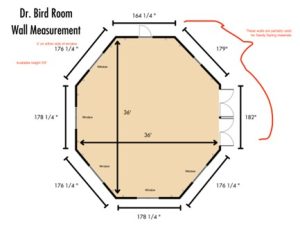
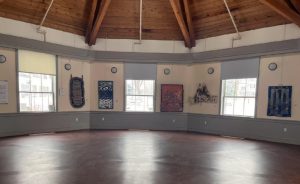
The Dr. Bird Room is hexagonal and will accommodate only wall pieces. The room is used for other functions so the central area must be kept clear. Ideal for larger items.
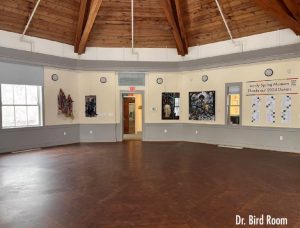
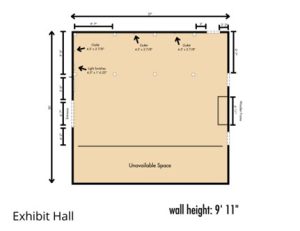
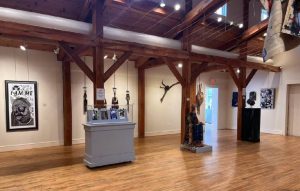
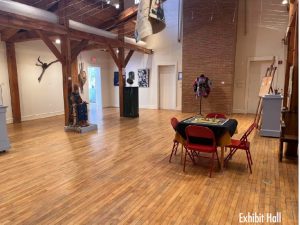
The Main Exhibit Hall has about ½ dozen cases of various sizes which can be used with or without glass tops. Items can be hung from walls and from beams (though delicate items may need to be protected on the back because the beams are rough wood). This room has fewer windows; good for light sensitive objects.
The Farquhar Gallery is a long hallway with brick walls on one side and lined with windows on the other (north light). This gallery also has cases.
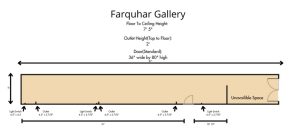
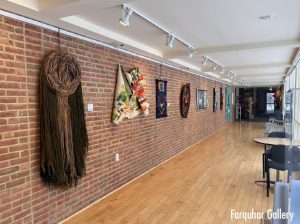
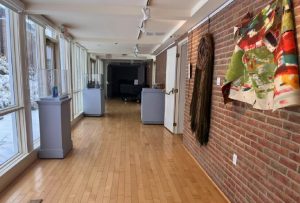
There is natural and artificial light in each room. We will need at least 40 items to display, though one participant on the call was involved with a display that included 80 items. The number of items will depend on their size. Another participant on the call has worked with the museum and said they are excellent at hanging items – they will do the install. The museum also has some handwoven objects that we can display if needed.
Hanging Items
The following illustrations provide details on how items will be hung for display. For full-size resolution, check out this file: SSM Hanging Specifications.
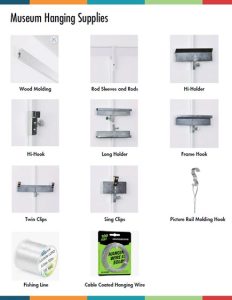
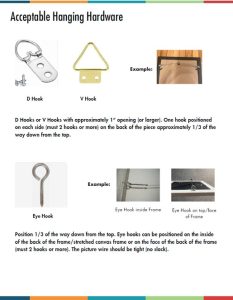
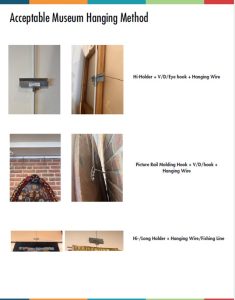
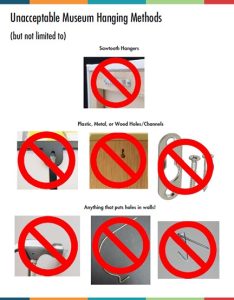
Most of the hanging hardware is designed for wired picture frames. Note the illustration with Hi-/Long Holder + Hanging Wire/Fishing Line. This may be appropriate for many textiles. More details on hanging will be provided as we get closer to the date.
We will standardize hanging methods:
- Wood-toned hangers
- Black hangers
- White hangers
- Fishing line to suspend hangers from hardware supplied by museum
Suggested approaches
- Sew loops that are only visible on the back of the textile.
- Doubleweave pockets can accept rods or other hanging devices.
- Drape and secure textile over a dowel.
- Hook and loop hanging devices (Velcro).
- Clothing may be on a hanger or dress forms (we will request dress forms from members).
- Poster hangers which can be purchased from Amazon or Michaels.
Distant Member Participation
You do not need to be local to participate. We encourage distant members to participate. We will provide an address for members to mail their items. The guild will pay for return shipment.
Other Ways of Participating
- Historic textiles (need not be colonial)
- Donate fiber to use with the tapestry loom that will be the hub for community weaving. (A donated Glimakra tapestry loom will be used for this event. If this gets filled up, the museum has a tapestry loom we can use as well.)
- Volunteer to demonstrate weaving and spinning—we expect at least two events. (We will check to see if we can store demo equipment somewhere safe in the museum.)
- Join us for the opening reception
For demos, it would be good if it could be hands-on. Need not be make-and-take.
Timeline
January – March, 2026: Sarah will send out a survey to get an idea of what people are making, how large the items are, what are the needs for hanging, etc.
July 16: Museum needs a full list of all work to be displayed so they can print labels. We will confirm the information needed for each label—will get this information to members as soon as possible.
The museum will also make two poster-sized signs for free. We can pay for additional if needed.
July 2026: Items will need to be submitted. There will be a range of dates, to be determined.
Questions?
If you have questions, please contact Sarah Mackowski directly: smackow@gmail.com
You don’t need to let her know about specific items for display – just ask if you have general questions like how to display items, sizes of items, etc.
If you’d like to collaborate with others, check with study groups or simply send an email to the Google Group.