Zoom Session from Nov 23, 2025
Text and demonstrations: Mary Pflueger, Videographer: Ann Rader
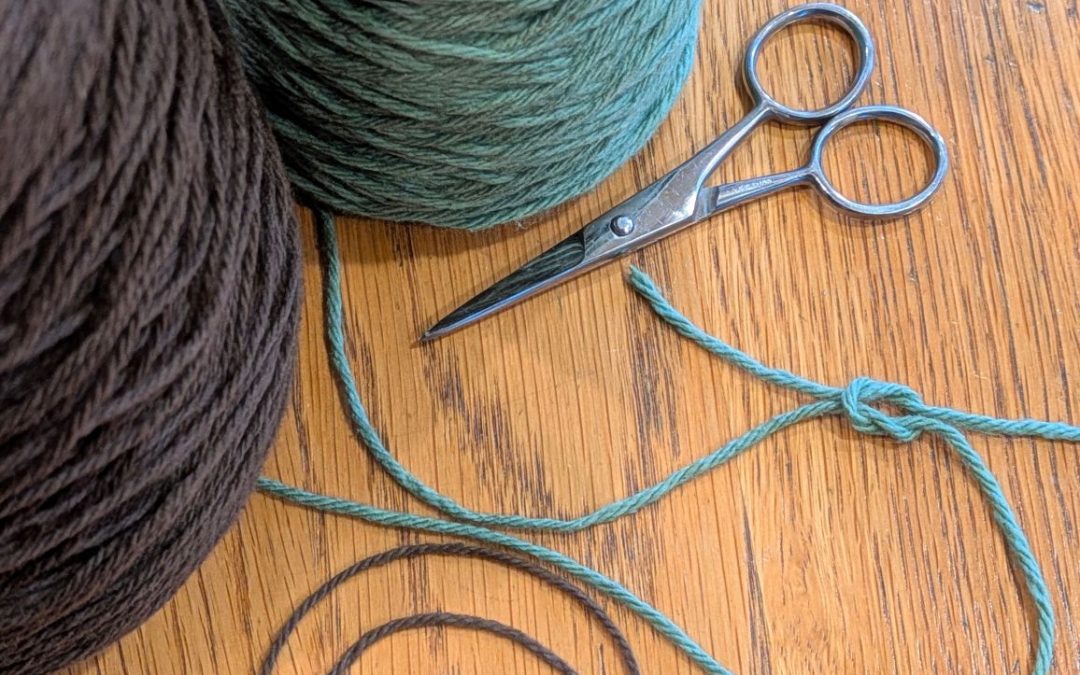
This Hangout was a demonstration of knots every weaver should know. You can view videos of each knot along with written descriptions.
NOTE: RH = right hand; LH = left hand
Supplies needed: scissors and sturdy yarn (like 3/2 cotton or 8/4 carpet warp) in two colors.
Slip knot
- Cut piece of yarn 12-15”.
- Hold yarn in LH between thumb and index finger ¾ of the way down the length.
- Take the longer length, at the half way point, in the RH, bring it around and up crossing it with the other length between the thumb and index finger of the LH forming a loop.
- Take the thumb and index finger of your RH into the loop, grab the end at the top of the loop. Pull RH to the Right and LH to the Left.
The slip knot is useful to attach to the peg when starting to wind a warp. It is also useful to gather ends together after threading a group of heddles, and after sleying a group of ends through the reed.
This knot can be used with a doubled length, knotted at one end, tying a slip knot at the other end.
Square knot
- Cut piece of yarn 12-15” long.
- Take one end in the RH and one end in the LH. Tie the Right end over the Left end, and then tie the Left end over the Right end. “Right over Left, Left over Right.
This is a very strong knot, difficult to untie. In a repair heddle, it is used at the bottom and top of the heddle eye.
Surgeon’s knot
- Cut piece of yarn 12-15” long.
- Take one end in the RH and one end in the LH. Tie the Right end over the Left end TWICE, and then secure with the Left end over the Right end once.
This knot is useful to tie warp ends onto the front rod after sleying the reed. The first part of this knot can also be used to secure warp ends at intervals after you have wound a warp as it holds snugly in place.
Weaver’s Knot (variation)
- Cut two pieces of yarn, dark and light, each 12-15” long.
- Hold the dark piece between the LH thumb and index finger with the short tail facing out to the Right. Take the light piece and place it behind the dark piece between the LH thumb and index finger with the short tail facing up.
- Take the long light length and loop it around the thumb, bringing it back in between the 2 short tails and securing it between the thumb and index finger.
- Take the dark tail and put it through the loop. Take hold of the short dark and light tails with your RH thumb and index finger; pull it up and pull the longer light length down and tighten.
This knot can be useful when tying ends from a new warp onto an old warp. It results in a very small knot.
(You can also put the two ends of the old warp and new warp together using an overhand knot.)
Midshipman’s hitch or knot
- Cut piece of yarn 20-24” long.
- Fold the piece so that the length is double and lay on table. Hold the end of the right length stationary with your LH throughout the entire knotting process. With the other length, the active length, make a half hitch around the stationary length.
- Wrap the active end once more around the stationary length.
- Bring the active end down below the wraps and make another half hitch around the stationary length.
- Tighten the knot. To lengthen or shorten the loop, grasp the stationary length and pull the knot down or up.
This is from Doramay Keasbey’s book on weaving a transparency, Sheer Delight, and it is used, with the help of a dowel, as a sling to raise or lower the transparency cartoon close or away from the warp.
Lark’s head
- Cut piece of yarn 24” long.
- Double the piece over; put the two tails together and tie in a knot.
- Hold the doubled length in the LH between thumb and index finger. Bring the thumb and index finger of the RH through the loop, back to front, grasp the two lengths and pinch, letting the loop roll off the thumb and index finger.
The lark’s head is useful for weighting warps when winding back to front onto the loom. A lark’s head is made around the warp loops at the front of the loom and also around the neck of a water bottle used as weight.
It can also be used when weighting a skein of handspun while letting it dry.