Zoom Session from December 7, 2025
Moderated by Ann Rader
Guild members had access to a film, The Nettle Dress, directed by Dylan Howitt. The film is not available on streaming services because the intent is to watch it in community. Though we couldn’t meet in person, we joined together for a discussion about the film and the related video Q&A session, a few days later. Here are some impressions from viewers:
- The film was meditative, calm, soothing. The focus on the process, the gentle repetition, the slowness of every step – “I could have watched this all day.” It was beautifully filmed and peacefully showed the entire process of cloth.
- The film focused more on the emotion of creating cloth rather than the details of the process, but so much was shown – spinning while walking, spinning and plying his own sewing thread (!), preparing the loom, hemstitching, cutting cloth.
- “I got the sense that it’s almost in our DNA to make cloth.”
- “The film was like falling into a dream.”
- “Allan described plain weave as ‘over the moon and under a spell.’ I’ll keep that with me whenever I weave.”
- You spin the thoughts and emotions of every moment into your yarn. You lay your life down into the cloth. As he spun while his father was dying, all the memories of what was happening at the time were spun into the yarn. “I’m part of the thread and the thread is a part of me.”
- When he wrapped himself in the cloth after removing it from the loom, he said it was like armor to defend himself from the arrows of his experiences and loss. The cloth went from sting to protection. But it also seemed like a shroud, or perhaps a prayer shawl.
- His project had to achieve some magic that we don’t normally aspire to in our spinning and weaving.
- It was interesting that he made a dress for his daughter, not a shirt for himself. And the blanket he made for his father was only used a few weeks.
- You put yourself into every bit of the textile – every beautiful part, every mistake.
- Non-weavers who joined to watch came away with a better understanding of what we do as spinners and weavers.
- This was a second viewing for one member: “The beauty of the film made a deeper impression on me – the landscape, the plant itself.”
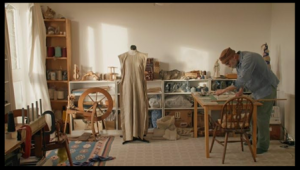
- “I paused the video so I could better see his studio – the handspun yarn, the distaff with flax, the Ashford wheel, the counterbalance loom.”
- What was the process that used the rock? As he struck the woven cloth, you could see the change in the fabric. The nettle cloth seemed crisper that linen, so the easy drape of the dress was surprising. The production of linen also uses stones to smooth the fabric, resulting in better drape and softer fabric. Suzi Ballenger talks about mangling to finish linen and give it a supple hand. It sounds like it’s a similar process with nettle.
- He collected and spun for years before weaving for a relatively short period of time. Spinning is always the rate limiting step in producing cloth.
- Boiling the fabric makes a big difference. Not only does it clean the textile but it also softens it. Even clean stricks of linen, when boiled, will release a lot of dirt.
- When he started cutting, you could see the care he took – little snips, so cautious. He had been building up to this moment for years. Cutting it was as slow, organic, natural, and rhythmic as the spinning and weaving that came before.
- The construction was equally careful, such as when he used enclosed seams to prevent the cloth from raveling.
- Allan said that there is so much waste with throw-away clothing. When this dress is worn out, it will go back to the earth directly. This was a quiet rage against plastic fast fashion.
- This film exemplified the concept behind the Fibershed movement – when an article of clothing is worn out, it should be able to go into a compost bin.
- Historically, pieced quilts use fabric from leftover clothing or scraps from the process of making clothes. You can use thrums from weaving – tie them together to make weft for weaving zanshi cloth. Or you can cut worn cloth into strips to weave cloth out of rags (sakiori).
- One of our weavers is in the process of “growing” a dress – raising flax to spin and then to weave into fabric. Another weaver has pledged not to purchase any clothing – only wear what she can make.
- We could do something along these lines with fabric – analogous to living a year without plastic, or without sugar, or without generating any garbage.
- Linen production is a very different process – requires “manhandling.”
- Dogbane can also be processed to produce bast fiber yarn.
- Similarly milkweed can be processed to create yarn. Sarah Swett has a Substack about her experiences with milkweed: https://sarahcswett.substack.com/p/milkweed-lessons?utm_source=publication-search
- The fable he told was The Wild Swans by Hans Christian Andersen, about the young woman whose seven brothers were turned into swans. They could only become human again once she spun nettle to make shirts for them.
Questions Raised by the Film:
- While the film was more about the internal process (which was beautiful), some came away wanting to understand more of the details of spinning and weaving itself.
- We learned that he wove 25 feet of cloth and it was 2 feet wide. What sett was used?
- Was it 14,000 yards spun?
- Was the yarn used for weaving singles or plied?
- We saw him sample on the table loom. Was this sample cloth what was used for the sample dress on the doll?
- What was the name of the book on clothing from which he took the Viking pattern for the dress?
- Did he have electricity in his shop? There seemed to be candles – were these a major source of light?
- What proportion of those seven years were actually spent on making the dress? How did he make a living during those years?
- Someone remembered hearing that Allan Brown mentioned that he was self-taught, that he learned the spinning and weaving process from YouTube. Is this the case?
More Viewing and Listening:
- Here is a Textiles and Tea interview with Allan Brown: https://www.youtube.com/watch?v=i4NVA1jfp64
- Long Thread Podcast – several interviews with both Allan Brown and Dylan Howitt: https://podcasts.apple.com/us/search?term=Nettle%20Dress
- Suggest taking a look at books by Max Tilke on Costume Patterns and Designs. (Out of print but available used)